ATTENTION: Experienced professionals who are cautious about becoming too dependent on AI, but know they can't afford to fall behind without it.

You Spent Years Developing Your Expertise. Now AI Has Changed What It Takes to Stay Valuable
What made you valuable for the last 5 years may not make you valuable for the next 5. The value of expertise has already changed.
Live on Zoom. Saturday October 24

20,000+ executives mentored
53 countries
PhD, Neuroscience
Founder, Cognitivistics of Influence™
20,000+ executives mentored

53 countries
PhD, Neuroscience
Founder, Cognitivistics of Influence™
Past clients have led at:


You’re right to be cautious.
If you’re an established expert, seasoned leader, senior manager, or executive, you’ve probably felt it:
Work that once required specialized support can increasingly be done by fewer people.
Your team is experimenting with tools you may not fully understand.
People bring AI-generated recommendations into meetings and expect you to evaluate them.
Leadership wants greater productivity, but the rules governing acceptable AI use are still evolving.
Skills that took years to build are accessible to someone with considerably less experience.
And underneath all of this, one question keeps surfacing:
“If AI can do more and more of the work that I gained expertise for… what will make me valuable from now on?”
That is the question this summit addresses.
Not because professional expertise is disappearing, but because the economics around professional expertise are changing.
“If AI can do more and more… what will they still need me for?”
This is the question reshaping how an entire generation of leaders is thinking about their next decade. We have an avalanche of job losses with companies deciding to invest their budgets into AI. At the same time, economists are predicting that a significant proportion of positions will be replaced by automation in the next five years.
The truth is, AI won’t replace everyone. It will elevate some people… and expose everyone else.
A deeper fear is that the market will no longer recognize the value of hard-earned expertise. But here’s the thing: in this day and age, hard work or productivity alone just won't cut it. That’s why the professionals who stay relevant in this next chapter will be the ones who adapt and evolve while understanding where their value belongs in the AI era.
Here’s what the market is already showing us
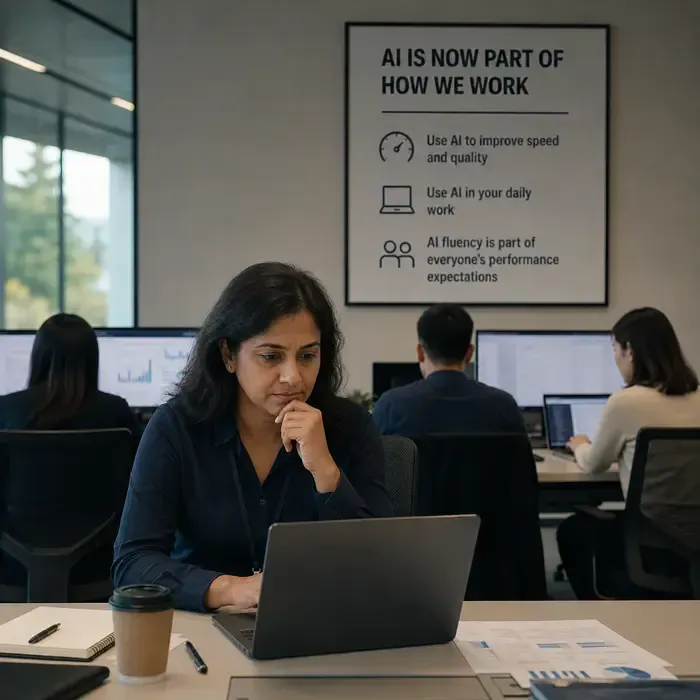
Until recently, many professionals could treat AI as an optional productivity tool. They could experiment with it or continue working largely as they always had.
That position is becoming harder to maintain.
In September 2026, Aviva Investors announced that generative AI use would become a formal objective for all employees beginning the following year, with leaders expected to model adoption.
Others have already begun linking AI use to bonuses, advancement, or expectations of continued employability.
AI-enabled performance is part of what competent contribution now looks like.
That’s the new professional standard.
Your organization may not have crossed that line yet.
But once employers begin expecting AI-supported performance, avoiding the technology can affect how your adaptability, capacity, and readiness for broader responsibility are interpreted.

Hard-earned expertise that set you apart is now easier to reproduce
For most of your career, your expertise created value partly because it was difficult to acquire and reproduce.
A strong analysis required someone who knew how to examine the information
A credible recommendation required someone who understood the subject.
A persuasive presentation required someone who could organize complex ideas.
A strategic plan required someone who could anticipate what might happen when the plan met reality.
The visible result carried weight because producing it required the accumulated capability of someone who knew what they were doing.

AI has altered that exchange.
Now, a less experienced professional can generate a credible market summary, presentation, proposal, research brief, strategic outline, financial model, or first-pass recommendation in a fraction of the time.
It does not guarantee that the output is accurate or strategically sound.
But it does make some of the visible results that once demonstrated your expertise much easier to produce.
And when something becomes easier to reproduce, the fact that you can produce it no longer distinguishes you in quite the same way.
If AI makes a form of output easier for many more people to perform, being excellent at producing more of that work will no longer differentiate you the way it once did.
AI has commoditized some forms of execution while increasing the premium on higher-order contribution
This does not mean all expertise is losing value.
It means different forms of professional contribution are no longer being valued in the same way.
In this day and age, hard work or productivity alone just won't cut it.
Producing more output is not automatically the same thing as becoming more valuable.
The marketplace does not reward effort; it rewards contribution.
It means that the value exchange around your expertise has changed. And that creates a problem most professionals have not yet fully recognized.
Your Expertise Isn’t the Problem

The Old Rules:
The Era That Built Your Career
Experience secures relevance
Quality output is rewarded
Competent execution earns advancement
Internal relationships protect tenure

The New Reality:
The Era Already Underway
Experience must be repositioned
Insight, foresight, & discernment are rewarded
Strategic leverage earns advancement
Strategic visibility creates influence

In fact, you may be better at what you do today than you have ever been.
You know more, you’ve seen more, made mistakes and learned from them, and developed instincts that someone earlier in their career simply doesn’t have.
The value exchange around your expertise has changed.
Organizations can now obtain more credible capability, more quickly and from more people, without relying on the same depth of experience at every stage of the work.
For years, organizations rewarded you for being able to produce what others could not.
Now, the organization may be able to access a similar-looking output from someone with less experience, a smaller team, or one person using AI.
The result does not have to be equivalent to mature expertise.
It only has to be good enough to change how much time, headcount, or specialized support the organization believes the work requires.
Nothing about your own capability has to decline for your professional position to weaken.
Which means you can continue delivering excellent work, receive positive feedback, and become more productive than ever while your organization becomes less dependent on the form of contribution you have mastered.
What nobody told you about the changing landscape
Your company may never issue an announcement saying that AI has changed the value of your role.
You may see the shift first through a smaller team, fewer support layers, slower advancement, or an expectation that one person should now produce what once required several people.
You may notice that a vacant position is not replaced, or responsibilities are redistributed instead of rehired.
That leaders expect faster answers with fewer resources, or a role keeps the same title while the standard of contribution underneath the title keeps rising.
This ambiguity becomes more serious since hiring is already constrained.
A slower market raises the consequences of waiting.
When external opportunities are plentiful, you still have considerable room to reposition elsewhere.
But when hiring is slow and employers are more selective, the cost of recognizing the changing landscape too late is much higher.
While using AI increases your production speed, it doesn’t automatically improve the underlying change in your value.

What Executives Say About Working with Dr. Grace Lee

"I was going for an interview as the Chief Information Security Officer. I didn't think I could get to the C-Level — I had been a VP for so many years. I thought VP was the highest level I could achieve. I got the job. That wouldn't have happened without Dr. Grace's advice."
Sunny N.
CISO, Global Manufacturer
"This morning I sat on a two-hour planning call with the CEO to work on the strategies he laid before us. I am literally at the table now — and I believe 100% that I made it there because of what Dr. Grace teaches. Especially in working with stakeholders, leading cross-functional teams, and feeling like I'm getting my true point across."
Kedrick G.
VP of Sales, Healthcare
"My only regret is sitting on the fence as long as I did. Dr. Grace's teachings on internal certainty have been the biggest help in my career. They played a large role in why I was promoted earlier this year and showed up at a level my team had not seen before."
Vince N.
Global Network Acquisition, Google
"This is the best investment I made this year — and the return is beyond my expectation. Within six months, this changed the entire way I see my career and how I see myself. I feel empowered internally and externally."
Kefirah K.
CPO & CTO, Thought Leader in AI
"I was going for an interview as the Chief Information Security Officer. I didn't think I could get to the C-Level. I had been a VP for so many years. I thought VP was the highest level I could achieve. I got the job. That wouldn't have happened without Dr. Grace's advice."
Sunny N.
CISO, Global Manufacturer
"This morning I sat on a two-hour planning call with the CEO to work on the strategies he laid before us. I am literally at the table now, and I believe 100% that I made it there because of what Dr. Grace teaches. Especially in working with stakeholders, leading cross-functional teams, and feeling like I'm getting my true point across."
Kedrick G.
VP of Sales, Healthcare
"My only regret is sitting on the fence as long as I did. Dr. Grace's teachings on internal certainty have been the biggest help in my career. They played a large role in why I was promoted earlier this year and showed up at a level my team had not seen before."
Vince N.
Global Network Acquisition, Google
"This is the best investment I made this year, and the return is beyond my expectation. Within six months, this changed the entire way I see my career and how I see myself. I feel empowered internally and externally."
Kefirah K.
CPO & CTO, Thought Leader in AI
Work performance focused on delivering results efficiently does not make you more valuable
The productivity case for AI is straightforward.
It can reduce the time required to research a topic, organize information, prepare a presentation, compare alternatives, draft a document, or complete routine analytical work.
For organizations, those gains are attractive.
For you as an individual, greater output becomes a durable advantage only when the output itself remains scarce, difficult to reproduce, and meaningfully associated with you.

When the same technology increases everyone’s productive capacity, speed becomes an expectation rather than a differentiator.
The organization may receive more output from each person, while the relative value of that output continues to decline because it is easier to generate and less dependent on any one expert.
Let’s say AI helps you produce twice as much results but also helps everyone around you produce twice as much.
What has changed about your relative value?
As employers begin making AI use part of formal performance expectations, the productivity gain that separates an early adopter today can become the minimum standard expected from everyone tomorrow.
Once that happens, being able to produce faster does not necessarily move you ahead. It may simply prevent you from falling below the new baseline.
This is how an accomplished professional can become substantially more efficient without becoming more strategically valuable.
AI may help you perform your existing role at greater volume. But it does not tell you whether that work will continue to make you more valuable.
And it does not tell you what organizations will increasingly expect from the people they trust with greater scope, influence, and responsibility.
That is why “learn and adopt AI” is an incomplete career strategy.
So what makes you more valuable?
The answer is not to become an AI expert. With so many new tools and the speed at which these tools are constantly changing, who’s an expert anyway?
It is not to ignore AI and rely on your experience since we’re already seeing how AI use has already become an important metric of competent contribution.
It is not even as simple as focusing on the things AI can’t do because AI keeps changing what it can do!
Building your career around a reassuring list of supposedly "AI-proof" abilities is a dangerous assumption.
Employers will continue changing what they expect. Work that appears protected from automation today may look very different several years from now.
There is a more useful question to answer:
As AI changes what is expected, what will make my contribution more valuable?
That question changes how you interpret your experience and how you evaluate AI.
You begin to understand what you need to learn and what your next stage of professional growth will require.
It prevents you from becoming extraordinarily efficient at work that is becoming less differentiating.
And most importantly, you can begin making much more deliberate decisions about where your own professional value needs to go next.
That is the question at the heart of the Relevance in the AI Era Summit.
Introducing
Relevance in the AI Era Summit
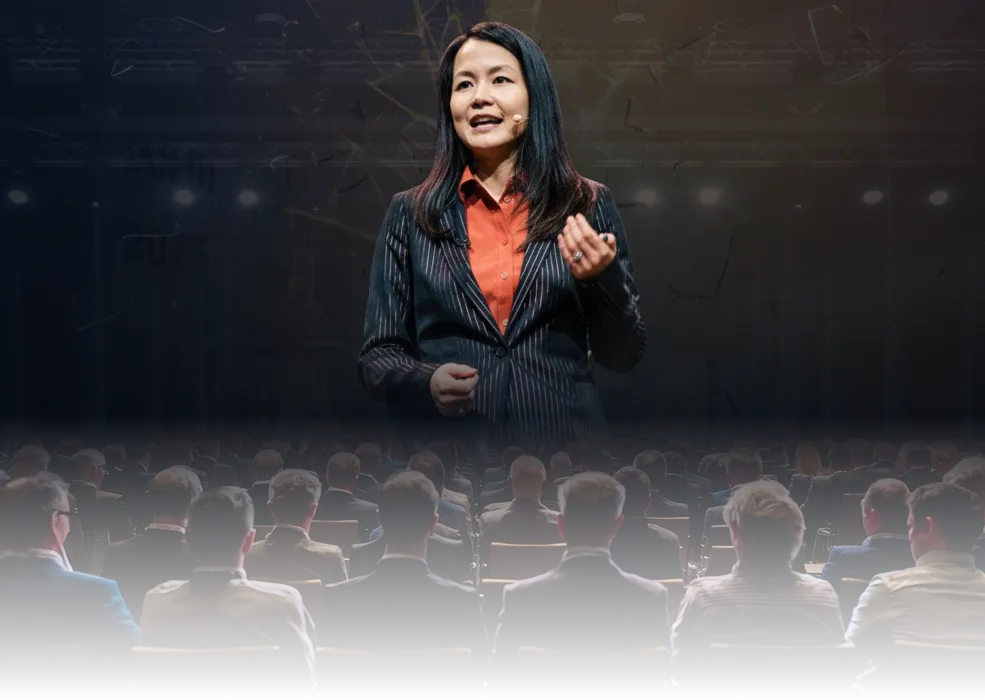
June 13 & 14, 2026
11 AM - 1 PM New York EDT
LIVE on Zoom
Saturday October 24, 2026
Principles first. No hype.
This is not a conference about the newest AI tools or a prompting workshop.
It is not technical training for people who want to become engineers.
And it is not another motivational presentation promising that human beings will always remain valuable simply because they are human.
Relevance in the AI Era is a strategic summit for accomplished professionals, experts, and leaders who need a clearer answer to what AI is changing around their work and what those changes require from them.
Most AI education starts with the technology itself.
This summit starts with the professional problem the technology has already created.
You do not need more information.
You need to know what it means for you.
The market is saturated with AI news, predictions, tools, prompts, demonstrations, and competing claims about the future of work.
One expert says your profession is about to disappear.
Another says AI will simply make everyone more productive.
One company announces layoffs while investing in AI.
Another promises that AI will create more jobs than it replaces.
Consuming more information does not necessarily create greater clarity.
It can leave you with more facts and less certainty about what any of them mean for your career.
This summit is designed to help you move beyond the noise and answer the questions underneath it:
What is genuinely changing around the value of professional work?
Which apparent threats are overstated, and which shifts deserve serious attention?
Why can greater productivity improve your performance without improving your position?
How do you use AI without allowing it to weaken the capabilities beneath your expertise?
What does remaining relevant require when the standard of contribution itself is moving?
We will not attempt to predict every tool, role, or organizational decision.
We will build a way to understand the shift well enough that you can make better decisions as it continues.
The Old Rules:
The Era That Built Your Career
Experience secures relevance
Quality output is rewarded
Competent execution earns advancement
Internal relationships protect tenure
The New Reality:
The Era Already Underway
Experience must be repositioned
Insight, foresight, & discernment are rewarded
Strategic leverage earns advancement
Strategic visibility creates influence
Why Listen to Me?
I didn’t get here by chasing trends. Instead, I believe in developing and deploying thought leadership through the accumulation of specialized knowledge, the synthesis of that knowledge into durable insights, followed by the strategic application of those insights that turn into wisdom.
Over the past decade, this work has served 23,000+ executives and professionals across 53 countries, including leaders from organizations such as Google, Bloomberg, Morgan Stanley, Bank of America, Oracle, and Delta.
My PhD in neuroscience taught me to look beneath visible behavior toward the upstream cognitive processes that produce or prevent productive leadership outcomes.
I am founder of Mastery Insights and the creator of Cognitivistics of Influence™, the applied study of how thinking, language, and embodied presence interact to produce influence and leadership impact.
I have also had to confront these questions inside my own company.
I built Mastery Insights into a global business while learning how to apply AI at scale without allowing the technology to determine the thinking, relationships, or leadership principles underneath the business.
I am not an AI educator, so I do not teach tools, prompts, or workflows. There is no shortage of people who do that well.
What I teach is the deeper layer beneath the tools: how professionals stay relevant, influential, and increasingly valuable when the landscape surrounding their expertise has changed.
That is the question this summit answers.
"Dr. Grace Lee teaches things I haven't seen in books or other trainings — but she does it with such profundity, clarity, and applicability that the skills begin to follow for you. She gave me frameworks to better articulate my message, and importantly, how to show up, be more visible, and be more impactful with my stakeholders."
— Demi O.
"Dr. Grace Lee has first-hand knowledge of human psychology, neuroscience, and deep industry experience. Her knowledge helps you understand yourself better, and gives you a real way to navigate the corporate world."
— Estella M.
"Dr. Grace Lee teaches things I haven't seen in books or other trainings, but she does it with such profundity, clarity, and applicability that the skills begin to follow for you. She gave me frameworks to better articulate my message, and importantly, how to show up, be more visible, and be more impactful with my stakeholders."
Demi O.
"Dr. Grace Lee has first-hand knowledge of human psychology, neuroscience, and deep industry experience. Her knowledge helps you understand yourself better, and gives you a real way to navigate the corporate world."
Estella M.
What you will discover at
Relevance in the AI Era Summit


Strategic Relevance
Why your expertise is not obsolete, but must be repositioned.
How to create and convey your most valuable contribution that no AI can replicate.
Build a career trajectory that compounds, regardless of how AI evolves.
Exude AI-informed leadership without sounding uninformed, defensive, or overly hyped.


Conscious AI Leverage™
The most important difference between productivity and leverage.
Where AI should assist your work and where human discernment must lead.
How to use AI as a partner to your thinking; not a replacement for it.
The principled framework for AI use that protects your reputation, trust capital, and leadership authority.


The Integrated Professional
Moving from competence to influence—why the path is not "do more."
How to position yourself for recognition in an era where output is amplified for everyone.
The frameworks for achieving internal certainty and external authority—and why this is the foundation under all the rest.
Translate AI-leveraged expertise into strategic value, recognition, and visible influence.
This is just a preview of what we will cover:
The precise point when AI stops being an advantage and becomes an expectation: What initially separates an early adopter can quickly become the minimum standard employers expect from everyone. You will see why keeping up with that standard and increasing your professional value are not the same thing.
Why your track record can be strong while your professional advantage gets weaker: There is a widespread assumption that accumulated experience will continue protecting professional value without meaningful adaptation. You’ll learn how to evaluate AI use without dismissing its power or surrendering too much authority to it.
How AI can change your career without replacing your job: Your title may stay the same while team size, support, workload, decision authority, and expectations change significantly beneath it. You will learn to navigate the subtle changes that often appear before anyone formally redefines the role.
The productivity trap that accomplished professionals are especially likely to miss: Many professionals use AI to produce more, work faster, and handle greater volume and still feel uncertain about the value of their contribution. The summit explains it in a way that brings greater clarity about where to invest your attention.
The two opposite mistakes professionals are making with adopting AI: Both appear reasonable at first, but if you don’t recognize these as mistakes, you will seem to be more productive while leaving the deeper career relevance question unanswered.
Why expertise, AI fluency, and generic “human skills” are all incomplete answers: Each matters, but none explains on its own why some professionals will gain greater influence and opportunity while others become more efficient at work that is losing its power to differentiate them.
The signs that your organization may already be changing what it values: You will learn how to interpret those signals without overreacting to every workplace change.
The questions you need to answer before deciding what to adopt, delegate, or preserve: Rather than chasing every new tool or relying on generic predictions, you will develop a clearer basis for evaluating what AI means for your own role, experience, and direction.
And finally, your Professional Relevance Strategy: We will bring the ideas together so you leave with a more deliberate view of what deserves your attention, what may need to change, and how your professional contribution needs to evolve next.
By the end of the summit you will have
❶ A clearer understanding of how AI is changing the value of professional work
❷ A more accurate reading of the risks and opportunities surrounding your own expertise
❸ A principled basis for deciding where AI belongs in your work
❹ Greater clarity about the difference between becoming more productive and becoming more valuable
❺ A practical direction for strengthening your relevance as expectations continue to rise
Most importantly, you will no longer be trying to interpret the AI era through disconnected headlines, tool demonstrations, or other people’s predictions.
You will have a coherent way to think about what is happening.
And a clearer view of what it requires from you.
What Executives Have Said about Our Previous Live Summits
"My experience was quite phenomenal. I was expecting to just learn about leadership and management, but I walked out with more, and I'm reaping the benefits already."
Sophy M.
"This is not just a course that has inspired me. It has equipped me, and given me the right mindset and the tools that I can already start practicing at work."
Suhita H.
"Dr. Grace Lee doesn't just share information. She inspires you to think bigger and act bolder, to redefine your potential. She has a unique way of breaking down complex ideas into powerful real-world strategies that you can implement immediately."
Sagar A.
"The summit was full of principles that focused on you, your brand, and how you can grow as a leader and as a communicator. Every expert needs a coach to help him or her master their craft to get to the next level."
James G.
"My experience was quite phenomenal. I was expecting to just learn about leadership and management, but I walked out with more — and I'm reaping the benefits already."
— Sophy M.
"This is not just a course that has inspired me. It has equipped me, and given me the right mindset and the tools that I can already start practicing at work."
— Suhita H.
"Dr. Grace Lee doesn't just share information. She inspires you to think bigger and act bolder, to redefine your potential. She has a unique way of breaking down complex ideas into powerful real-world strategies that you can implement immediately."
— Sagar A.
"The summit was full of principles that focused on you, your brand, and how you can grow as a leader and as a communicator. Every expert needs a coach to help him or her master their craft to get to the next level."
— James G.
You will not get a warning before things change again
By the time AI appears in performance objectives, promotion criteria, workforce planning, or the formal expectations attached to your role, it is no longer an emerging trend.
It has become part of the operating environment.
The shift may begin subtly.
A faster turnaround expected here, a broader responsibility there.
A vacancy that is never refilled.
A colleague who can perform work outside the traditional boundaries of the role.
A leader who begins evaluating AI-enabled capacity as evidence of adaptability.
No single moment may feel substantive.
But over time, the basis on which professional value is measured can change considerably.
You do need to understand what is changing before you are forced to change your approach after the consequences have already begun.
That is the purpose of Relevance in the AI Era.
Common Questions
"I'm not technical. Will this be over my head?"
No. This summit is designed for accomplished experts and leaders, not engineers. We will discuss what AI is changing, but we will not teach coding, technical architecture, or advanced prompting.
If your work involves thinking, communicating, solving problems, advising, deciding, managing, influencing, or leading, the subject is directly relevant to you.
“I already use AI regularly. Will this be too basic?”
No. Using AI and understanding what AI means for your professional value are different questions. You may already be substantially more productive.
The next question is whether that greater capacity is strengthening your position, merely helping you meet a rising expectation, or keeping you focused on work that is becoming easier for others to reproduce. That is the level at which this summit operates.
“I barely use AI. Am I already too far behind?”
No. You do not need to catch up on every tool. Trying to do so is one of the easiest ways to become overwhelmed without becoming strategically clearer.
You need a sound basis for deciding which developments matter for your work, which do not, and how deeply AI should be integrated into the way you operate.
“What if I don’t trust AI very much?”
Your caution may be justified. AI can be inaccurate, generic, contextually inappropriate, or confidently wrong. The answer is not blind adoption. It is also not passive avoidance.
The summit will help you think more clearly about the necessary responsibilities when AI becomes involved in producing the results.
“Is this summit about protecting myself from layoffs?”
No one can credibly promise protection from layoffs. Workforce decisions are influenced by economic conditions, company strategy, management quality, technology, restructuring, and many other factors.
This summit focuses on the part you can influence: the level and nature of the value you contribute as those conditions change.
That matters whether your immediate goal is career resilience, advancement, broader leadership scope, stronger influence, or a clearer strategy for the next several years.
“My company isn’t very advanced with AI yet. Is this premature?
No. Your organization’s current adoption level is only one part of the issue.
AI is already changing customer expectations, hiring criteria, competitors, access to expertise, workflow design, and what one capable professional can produce. Understanding the shift before it becomes a formal expectation gives you more room to respond intentionally.
“What if I’m already senior in my career? Is it still relevant for me?”
Then you have accumulated valuable career capital: experience, pattern recognition, relationships, perspective, and the ability to understand consequences over time. AI does not automatically erase those advantages.
But experience only creates value when it is deployed in ways the marketplace landscape continues to reward. The summit will help you examine what the changing environment means for the next application of your experience.
"I'm already busy. Do I have time for this?"
Four hours over a weekend on the strategic layer will save you months of disjointed learning later. The leaders who navigate this transition well are not the ones with the most time. They are the ones who get clear about what actually matters before everyone else does.
"Will you tell me which AI tools to use?"
This is not a tool-selection seminar. And besides, the specific products will keep changing. This summit teaches the governing principles your professional relevance needs whether the dominant tool a year from now is ChatGPT, Claude, Gemini, or something none of us has seen yet. Tools may appear as examples, but they are not the foundation of the summit.
"What will I actually leave with?"
You will leave with:
• a clearer interpretation of the professional shift already underway
• a more precise understanding of what the shift means for your experience
• a principled basis for evaluating AI in your work
• a clearer direction for your next professional relevance decisions

Relevance AI Summit By Mastery Insights | Dr. Grace Lee
©2026 - All Rights Reserved
IMPORTANT: Results and Legal Disclaimers
For educational purposes only. Our role is to support and assist you in reaching your own goals, but your success depends primarily on your own effort, motivation, commitment and follow-through. We cannot predict and we do not guarantee that you will attain a particular result, and you accept and understand that results differ for each individual. Each individual’s results depend on his or her unique background, dedication, desire, motivation, actions, and many other factors. You fully agree and understand that there are no guarantees as to the specific outcome or results you can expect from using the information you receive on or through this website or coaching program.